
 Ua
 Ru

Samhain 2026: The Last Harvest
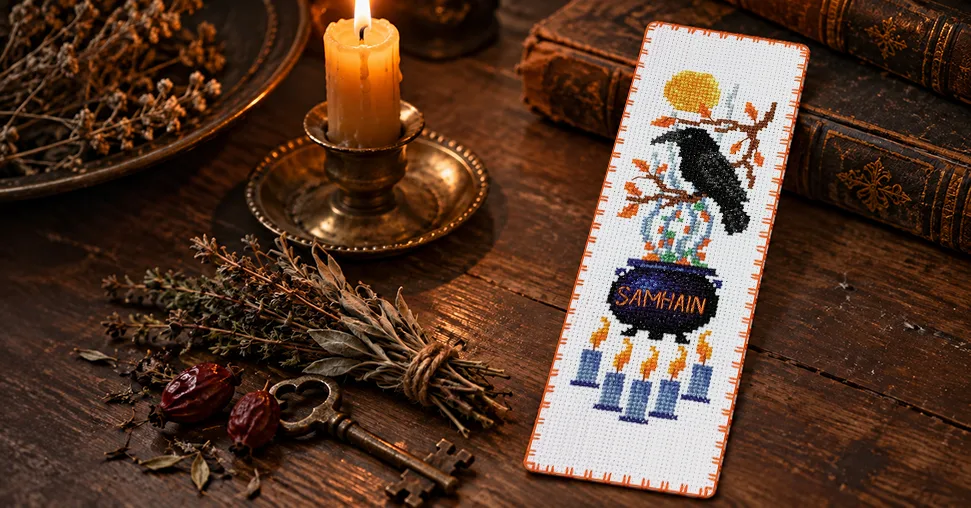
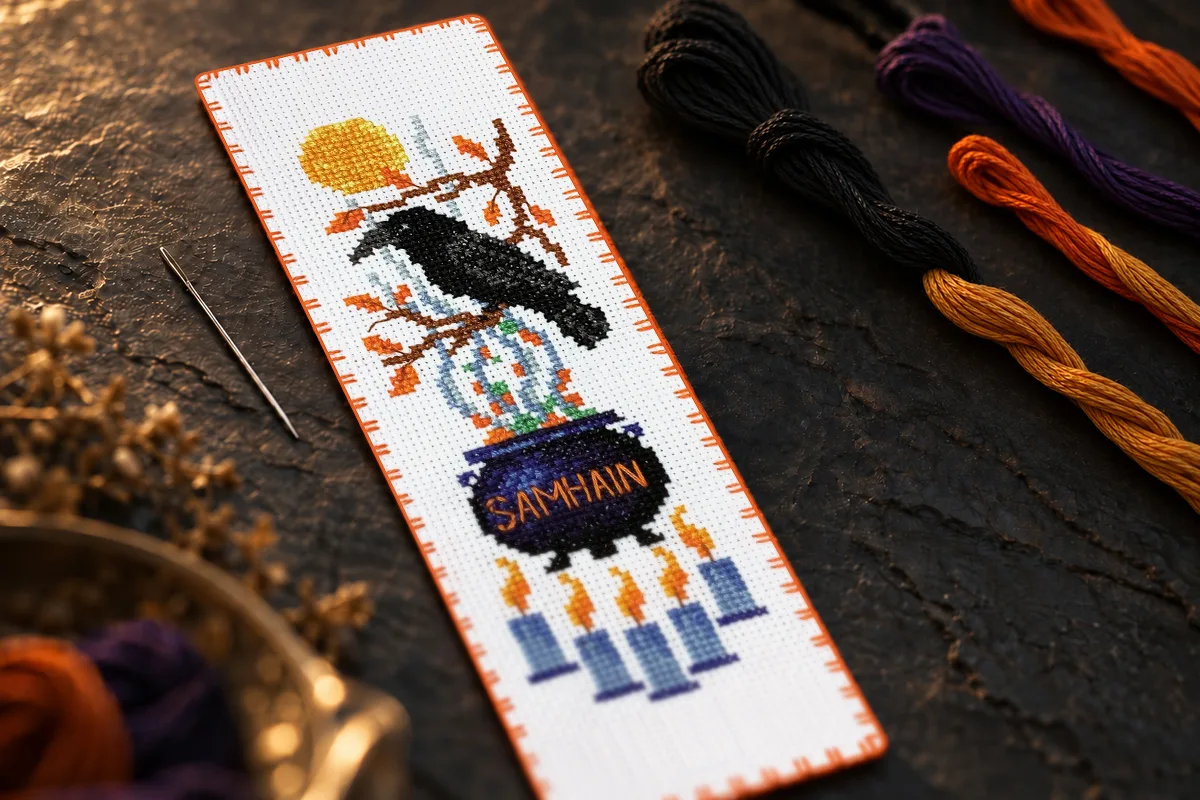
A golden moon hangs at the top. Below it, a black crow perches on a bare branch hung with autumn leaves. Beneath the crow sits a dark cauldron with the word SAMHAIN lettered across it in amber, a green mist rising from whatever brews inside. And at the very bottom, five blue candles burn with orange flames. There is no pumpkin anywhere on this bookmark, no grinning jack-o'-lantern, no ghost. The palette runs through blacks, deep purples, blues, amber, and gold, and the mood is nothing like a party. If you came here from our Halloween article, you have already crossed the line between the two holidays. This is the older, quieter story behind it.
The design is the Samhain bookmark (KSK2-269), part of the eight-bookmark Wheel of the Year collection. Every motif on it has a source, and none of those sources involve trick-or-treat bags. This article follows the images to their origins, explains what Samhain actually is, and ends where it belongs — with a needle, fourteen colours of thread, and the evenings getting longer.
The crow — why this bird
In Irish mythology a crow — or more precisely a hooded crow or a raven, the texts are not always specific — is the shape worn by the Morrígan, the figure associated with war, fate, and the boundary between life and death. Before the second battle of Mag Tuired, the Morrígan appears to the Dagda at a river ford; after the battle she takes the form of Badb, the crow, and proclaims the outcome from above. In the Ulster Cycle she lands on the shoulder of Cú Chulainn after he has tied himself upright to a standing stone so that he will die on his feet. Only when a crow settles on him do his enemies know he is truly dead.
None of this is Halloween imagery. It is far older and far less cheerful. A crow on a Samhain bookmark is not there for decoration — it is there because the festival sits on the same threshold that the Morrígan patrols in the stories: the place where the living world and whatever lies beyond it come closest to touching. In the manuscripts, it is always a bird that marks the crossing.
The cauldron — not the one you are thinking of
The cauldron on this bookmark is not a witch's prop. The image it draws from is the Dagda's cauldron, one of the four treasures brought to Ireland by the Tuatha Dé Danann in the Lebor Gabála Érenn. It was called the Undry, and its property was that no company ever left it unsatisfied. That is a harvest image: sufficiency, the reassurance that there is enough.
A second cauldron runs through the Welsh tradition. In the Mabinogion, Branwen's tale includes the cauldron of rebirth, into which dead warriors are placed and from which they rise again, alive but without speech. That is a different idea — regeneration rather than plenty — but it sits on the same border between ending and beginning.
Samhain is the last of three harvests in the modern Pagan calendar. Lammas in August brought in the grain; Mabon in September gathered the fruit. By the end of October what remains in the fields is whatever the frost will take. The cauldron on the bookmark holds both ideas at once: the abundance of the harvest just completed and the transformation that follows when the year turns over.
The candles — for whom they burn
The most direct of the three motifs. In parts of Ireland and Scotland, and in modern Pagan practice that draws from those traditions, candles placed in windows on the night of Samhain are understood as a guide for the dead. The custom is quiet and domestic: a light left burning, a door left unlatched, sometimes a plate set at the table.
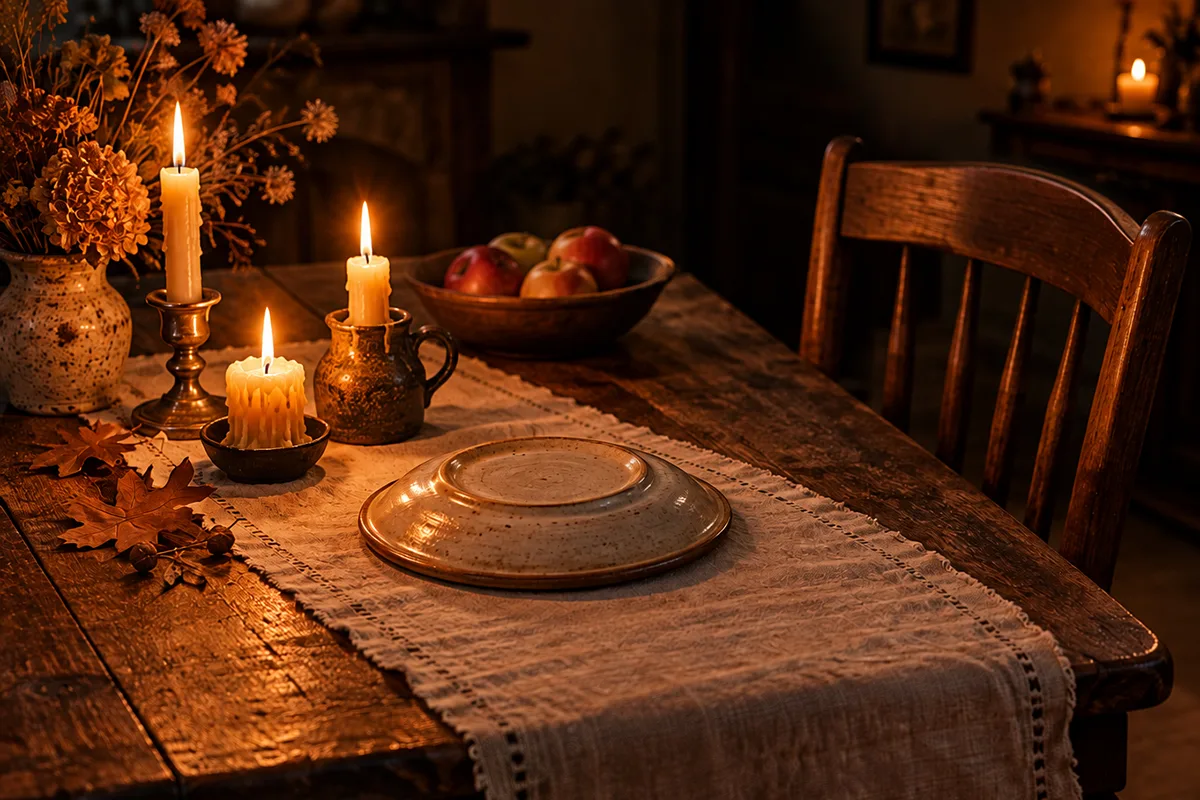
The fullest version of this is the dumb supper — a meal prepared and eaten in complete silence, with an empty place set for whoever has died during the year. Candles on the table, no conversation, and the empty chair acknowledged but not addressed. It is a living practice in parts of the modern Pagan community, and it is about as far as you can get from a costume party.
The five blue candles on KSK2-269 sit below the cauldron, at the base of the bookmark, their flames orange against the white Aida. Read from top to bottom, the design tells a simple story: the moon watches from above, the crow perches on its branch over the cauldron, the cauldron holds the year's last gathering with the name of the festival written across it, and the candles light the way for those who are not at the table.
What Samhain actually is
Now that the images have context, the name will hold more weight.
Samhain (pronounced roughly SAH-win; the mh in Irish is a w sound) is a Gaelic festival marking the end of the harvest season and the beginning of winter, or the "darker half" of the year. The name appears in medieval Irish literature — among the earliest references is the tenth-century Tochmarc Emire — as one of the four major seasonal turning points of the Gaelic calendar, alongside Imbolc (February), Beltane (May), and Lughnasadh (August).
In the medieval texts, Samhain is the night when the boundary between this world and the Otherworld — the sídhe, the mounds where the Tuatha Dé Danann retreated — is at its thinnest. Much happens on Samhain night in the sagas. In Togail Bruidne Da Derga the destruction of a king's hall falls on the festival. In the Fenian Cycle, Aillen emerges from the Otherworld each Samhain to burn Tara with his breath, until the young Fionn stops him. In the Ulster Cycle, encounters between mortals and beings from the Otherworld cluster around the same date. Whether ordinary people in early medieval Ireland experienced Samhain as these stories describe it, or whether the storytellers used the date the way a modern screenwriter uses midnight, is not something the sources settle clearly.
What is clear is that Samhain is not "the Celtic god of death." That claim appears regularly online and has no basis in any surviving text. It seems to trace to a misreading by Colonel Charles Vallancey in the eighteenth century and has been repeated without correction ever since.
When is Samhain 2026?
Samhain is conventionally observed on the evening of October 31 and into November 1. Unlike the solstices and equinoxes, it does not depend on an astronomical instant — there is no Samhain to the minute. The date is fixed by tradition, not by the sky.
Some modern Pagans mark it on the nearest weekend. Some extend it across three days. A smaller number observe it on the astronomical cross-quarter day, the midpoint between the autumn equinox and the winter solstice — in 2026 that falls around November 7. But October 31 is the date most people mean when they say Samhain.
Two Samhains from one studio
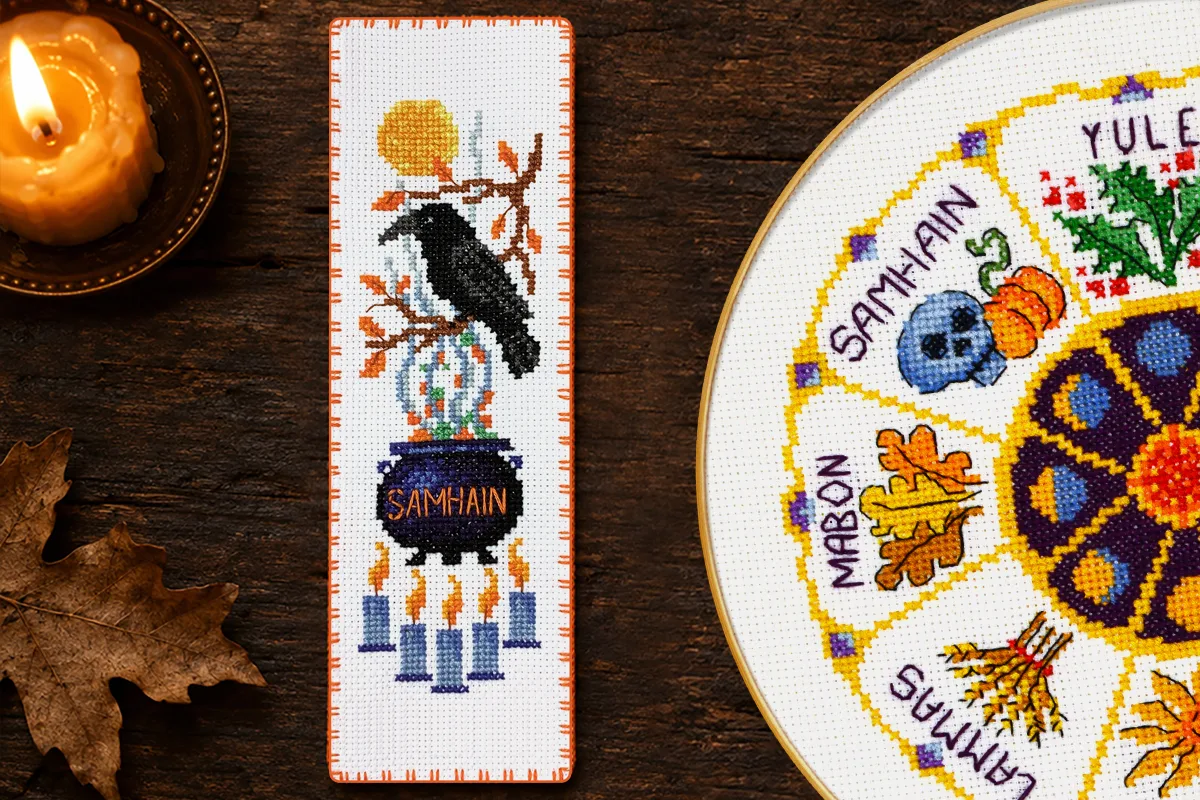
Here is a thing worth noticing. The Samhain bookmark shows a moon, a crow on an autumn branch, a cauldron, and five candles — dark, quiet, poetic. But if you look at the Wheel of the Year kit (P8-019), the circular chart that places all eight festivals in their wedges, the Samhain segment has a skull and pumpkins in bright orange and blue. Festive, instantly legible, a different mood entirely.
Neither is wrong. One is Samhain as a season on the Wheel — a quick visual marker that says "October, harvest, the veil." The other is Samhain as a single night with its own language — the language of the sagas, the candles, the returning dead. They come from the same studio, and they live on the same shelf. What you stitch depends on what you want the bookmark to say when it sits in your book.
The bookmark, stitch by stitch
The Samhain bookmark kit (KSK2-269) is the darkest in the eight-bookmark Wheel of the Year collection. Fourteen colours — that is more than Litha's nine, more than Mabon's thirteen — and most of them sit in the blacks, deep purples, blues, and ambers. The gold is there for the moon and the candle flames, the greens for the mist rising from the cauldron, and the effect when you see it finished is less a bookmark than a small stained-glass panel seen from outside at night.
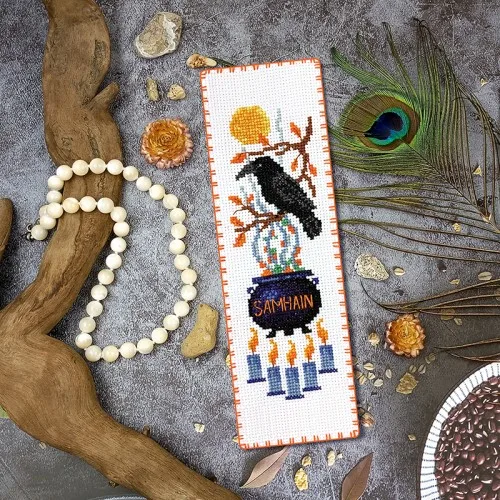
The kit includes the colour chart, white 16-count cotton Aida, mouline threads in all fourteen colours, and a metal needle. It is worked in full cross stitch over two strands, with back stitch for the outlines and a buttonhole edge — visible as the red-orange border that frames the whole piece. Like the rest of the Wheel collection, it is partly stitched: the background stays bare white, so the dark design floats on the cloth. Finished size is 6 × 19.5 cm (2.36 × 7.70 inches).
Fourteen colours make this one of the more involved bookmarks in the collection, but the partly-stitched format keeps the actual work contained. The background does not need filling. What you are stitching is the crow, the cauldron, the flames, and the border — and all of that fits into a few October evenings.
Samhain on the Wheel of the Year
The Wheel of the Year is the eight-festival modern Pagan calendar behind this series: four solar points — the solstices and equinoxes — and four seasonal festivals between them. Samhain falls between the autumn equinox (Mabon) and the winter solstice (Yule), the last festival before the longest night. In the three-harvest framework that many modern Pagans use, Samhain is the final harvest: whatever the land gives up before winter closes in.
Its opposite across the Wheel is Beltane in early May, the beginning of the light half. The two festivals mirror each other — fire and threshold, one opening summer, the other closing it. Both are associated in the Gaelic tradition with bonfires and with the movement of cattle, though in opposite directions: out to summer pasture at Beltane, home to the byre at Samhain.
The whole cycle also exists as one design, the Wheel of the Year cross-stitch kit (P8-019), a circular chart with each festival in its own wedge.
The wheel turns
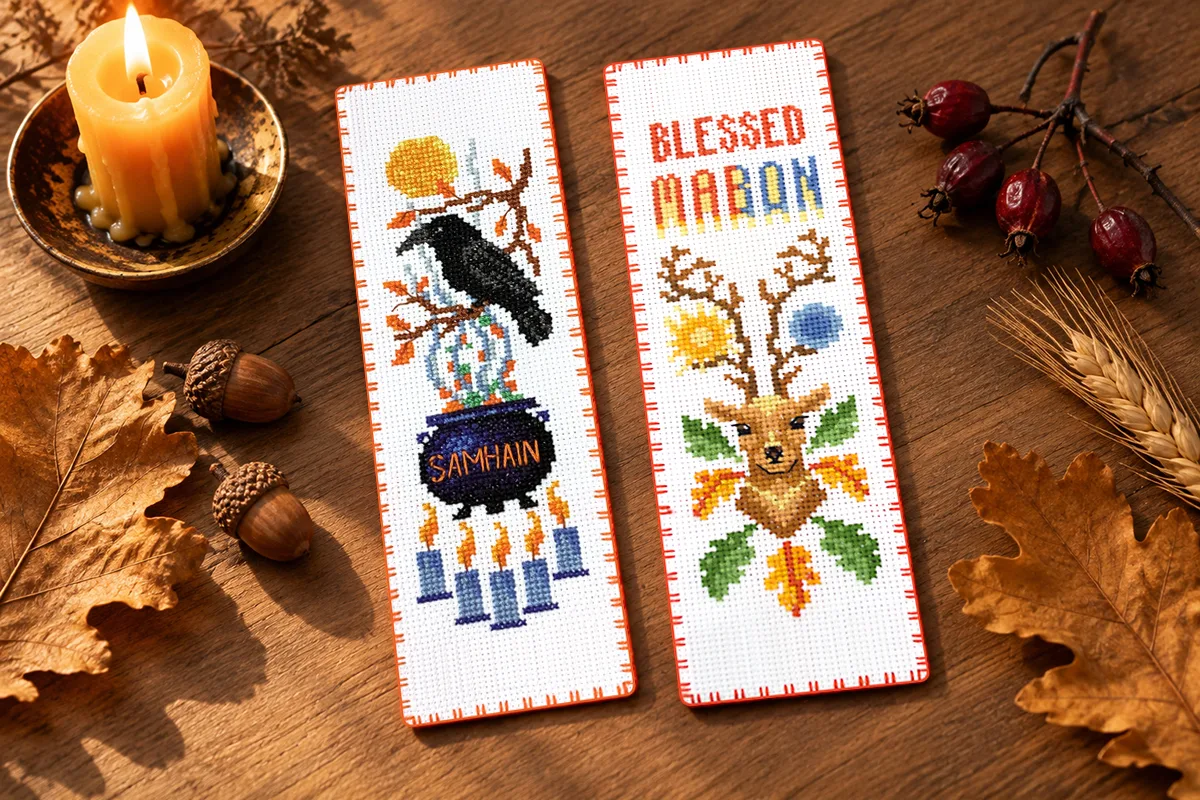
Mabon is behind us — the equinox, the stag, the balanced light. Its article is there if you want to read back. Ahead is Yule at the winter solstice, the shortest day, and its article will come when the dark is at its deepest. We started this series in June at the brightest point; the full map lives in the Wheel of the Year guide.
The evenings are long now and the light is low. That is Samhain's season — not the loud October of the costume shops, but the quiet one, the one with the candle and the book and the needle. A good time to stitch something small and dark, and to let the year turn.