
 Ua
 Ru
Saints Faith, Hope, Love, and Sophia: September 17 Feast Day and a Bead Embroidery Pattern
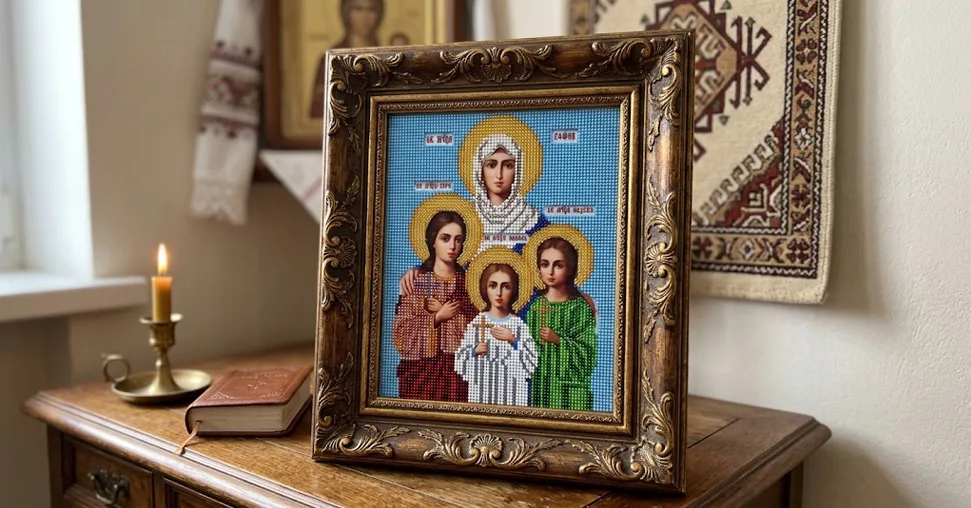
The church calendar holds a day when three female names share one feast. In Eastern tradition, Saints Faith, Hope, and Love (known in Greek as Pistis, Elpis, and Agape) are always commemorated together with their mother Sophia on the same date.
The short answer: September 17, 2026 is the day when churches using the Revised Julian calendar honor the holy martyrs Faith, Hope, and Love, and their mother Sophia. Communities on the Julian (old) calendar keep the same liturgical date on September 30 in the present civil calendar.
When is the feast day in 2026?
| Tradition | Date in 2026 | Day | Commemoration |
|---|---|---|---|
| New calendar (OCU and UGCC) | September 17 | Thursday | Memory of the holy martyrs Faith, Hope, Love, and their mother Sophia |
| Old (Julian) style | September 30 | Wednesday | the same commemoration — September 17 by Julian reckoning |
Both dates are the same church memory expressed in two calendar systems. The Julian calendar is currently thirteen days behind the civil calendar, which is why the same feast appears on different civil dates. In everyday speech, "name day" and "angel's day" are often used interchangeably; the relevant date depends on the calendar tradition of the person's parish.
A note for Western readers
In the Western tradition, these saints are sometimes called Faith, Hope, and Charity (using the King James rendering of "agape" as "charity"). The Roman Martyrology historically commemorated Sophia and her daughters on September 30. Some Western calendars place their memory on August 1. The feast is not widely observed in most modern Catholic or Protestant parishes, but the names remain familiar across Christian traditions.
Who were Saints Faith, Hope, Love, and Sophia?
Three sisters from Rome
According to church tradition, Sophia was a Christian widow living in Rome in the second century. She raised three daughters in the faith. Their names in the Greek tradition — Pistis, Elpis, Agape — translate directly to Faith, Hope, and Love. The Slavic names (Vera, Nadezhda, Lyubov) are exact calques of the Greek.
During the persecutions under Emperor Hadrian, Faith was about twelve years old, Hope ten, and Love nine. Each was urged to renounce Christianity and sacrifice to pagan gods. All three refused. Their mother stood beside them and offered her support.
After her daughters' martyrdom, Sophia prayed at their grave for three days. She soon reposed and was buried beside them.
Why these saints are always together
There is no separate feast of Faith, nor of Hope, nor of Love. The church commemorates them on one day alongside their mother Sophia. This is not an administrative coincidence but part of the tradition itself: three sisters embody three theological virtues, and the fourth figure who bore and raised them is Wisdom (in Greek, Σοφία).
The Apostle Paul wrote of these three in 1 Corinthians 13:13: "And now these three remain: faith, hope and love. But the greatest of these is love." Sophia is not a virtue in that list but, according to the tradition, the mother who nurtured in her daughters what the Church later enshrined in their names.
What the names mean
The names have Greek roots. Their Slavic equivalents are not loose translations but direct calques that entered living usage.
Faith (Віра / Вера) — from Greek Πίστις (Pistis). Means "faith," "trust," "conviction." The Latin parallel is Fides.
Hope (Надія / Надежда) — from Greek Ἐλπίς (Elpis). In theological context, this is not passive waiting but active confidence in what is good. The Slavic name preserves this sense: steadfast expectation rather than wishful thinking.
Love (Любов / Любовь) — from Greek Ἀγάπη (Agape). The highest form of love: unconditional, asking nothing in return. The name carries what most Christian traditions consider the greatest of virtues.
Etymology explains where names come from. It does not predict character, destiny, or personal qualities.
The icon of Faith, Hope, Love, and Sophia
This image depicts a mother together with three daughters — a rare collective type in Orthodox iconography. The tradition holds that such an icon resonates with families where there is a mother and several daughters, with women who bear these names, and with anyone who finds meaning in the image of spiritual steadfastness.
A hand-embroidered icon is not a charm and carries no guarantee of protection, healing, or answered wishes. It is an image for prayer and remembrance.
The T3-18 pattern: what the buyer receives
T3-18 is a bead embroidery pattern depicting Saints Faith, Hope, Love, and Sophia. It is not a finished icon but a color design printed on fabric, intended for PRECIOSA Czech beads.
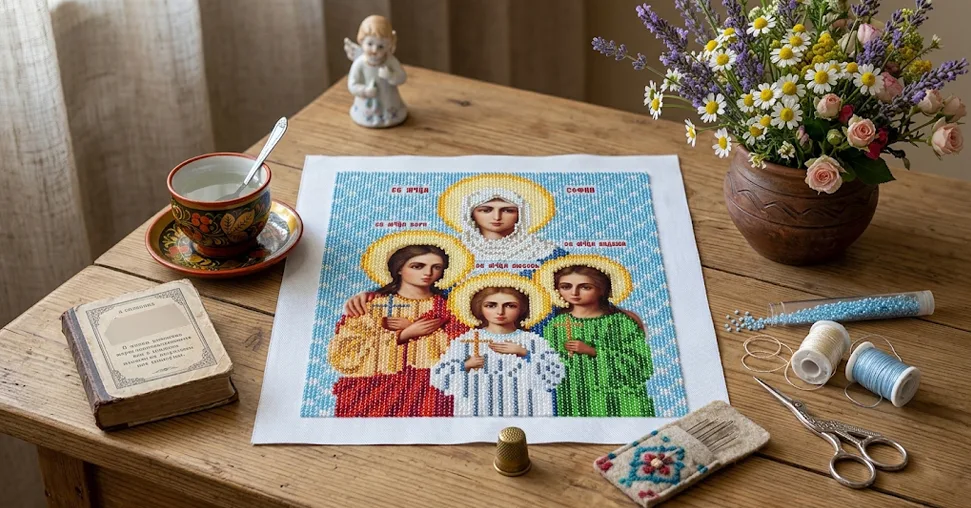
See the photo, format, and fabric on the T3-18 pattern page at Povitrulya.
Who might appreciate this project?
T3-18 is a fitting choice for someone named Faith, Hope, or Love celebrating a name day, or for a mother raising several daughters. Occasions may include name days, birthdays, or a family embroidery project shared between generations.
Embroidery holds the memory of time and attention invested in the work. It is a gift that carries meaning for both giver and receiver. A mother, daughter, or close friend may share the project.
More named images can be found in Povitrulya's religious bead embroidery patterns category. If you are still identifying a patron saint, start with our guide to patron saints and name icons.
Related Articles
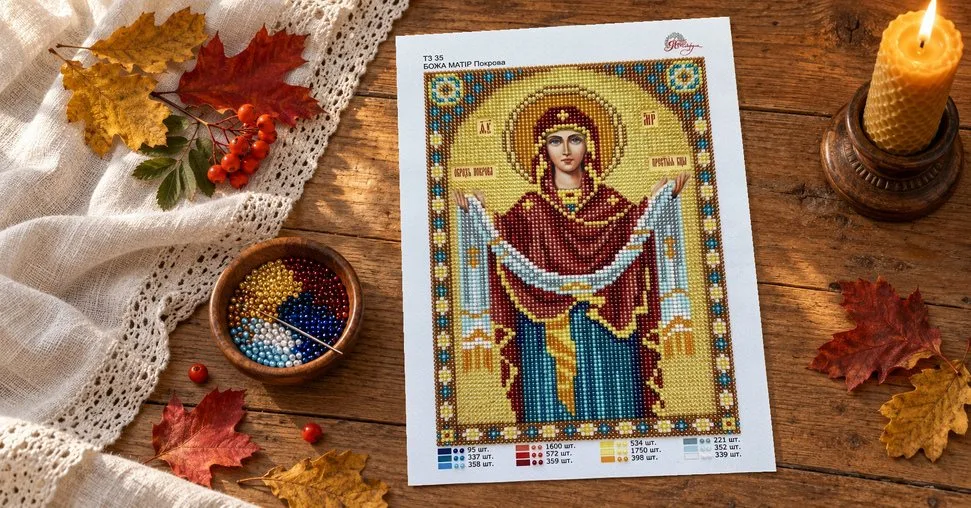
Pokrova, the Intercession of the Theotokos, October 1, 2026 — beaded icon
Pokrova, the Intercession of the Theotokos, falls on October 1 in 2026 for Ukrainian churches on the new calendar, October 14 on the old. The history, the Cossack tradition, and a bead embroidery pattern of the icon.